
Canada Tariffs 2026 Update: What US Importers Should Know
Every Canada Tariffs 2026 conversation among small business importers this August comes back to the same number: 50%. That is the additional duty now sitting on top of the normal cost of importing certain Canadian goods into the United States, and it landed with almost no runway for businesses that had already placed orders under the old pricing.
This tariff is narrow and targeted, hitting a specific set of Canadian goods, and for the businesses it touches, it is expensive. If your company imports Canadian alcohol, dairy, or motor vehicles and parts, this Tariffs 2026 action is probably already showing up in your landed cost calculations. If it isn't yet, it likely will the next time a shipment clears customs.
What actually happened
On July 20, 2026, the White House issued three separate proclamations under Section 338 of the Tariff Act of 1930, a statute that had not been used in decades. Proclamation 11046 covers alcoholic beverages, Proclamation 11047 covers dairy, and Proclamation 11048 covers motor vehicles. Each one imposes an additional 50% ad valorem duty on specific Canadian goods, layered on top of whatever duty already applied.
The legal reasoning behind each proclamation is the same: Canada, according to the administration, treats US exports in these three sectors worse than it treats exports from other countries, whether through provincial alcohol distribution rules, dairy tariff-rate quota allocation, or vehicle import quotas. Section 338 lets the President respond to that kind of discrimination with duties of up to 50%, and this is the first time in the modern era it has actually been used at scale.
Effective date and the three-day suspension
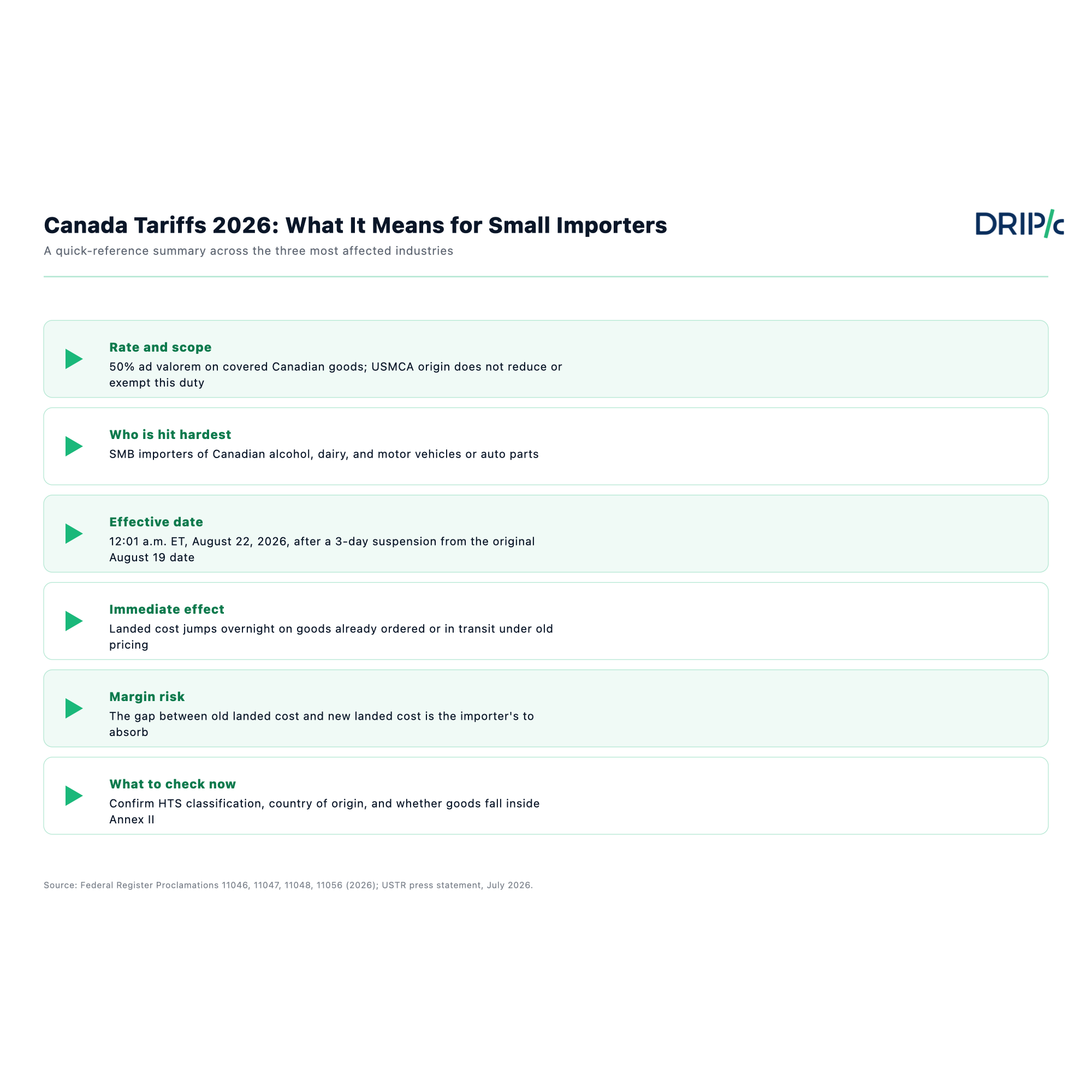
The duties were originally set to take effect August 19, 2026. A follow-up proclamation, Proclamation 11056, delayed that by three days while trade talks continued, pushing the effective date to 12:01 a.m. Eastern time on August 22, 2026. As of this writing, the US Tariff is in force at the new date, applying to goods entered for consumption or withdrawn from warehouse for consumption on or after that time.
That short suspension mattered less than it might sound. Three days is not enough time for most importers to reroute a supply chain, renegotiate a purchase order, or find an alternate vendor. For practical purposes, this Tariff update hit small importers on the same timeline whether it landed on the 19th or the 22nd.
No USMCA relief this time
The detail that catches most importers off guard: goods that qualify for preferential treatment under the United States-Mexico-Canada Agreement get no exemption from this duty. USMCA-qualifying dairy, alcohol, and motor vehicle products covered by the proclamations are still hit with the full 50%. That is a departure from how many earlier tariff actions worked, where proper origin certification could shield a shipment. Here, origin certification does not help.
By the numbers
By the numbers
Canada Tariffs 2026 at a glance
50%
Additional ad valorem duty on
covered Canadian goods
Aug 22
Final effective date after a
3-day suspension
~$20B
In annual Canadian imports
USTR says are exposed
3
Separate proclamations, one
each for alcohol, dairy, autos
Source: Federal Register Proclamations 11046, 11047, 11048, and 11056; USTR press statement, July 2026.
Industry breakdown: alcoholic beverages
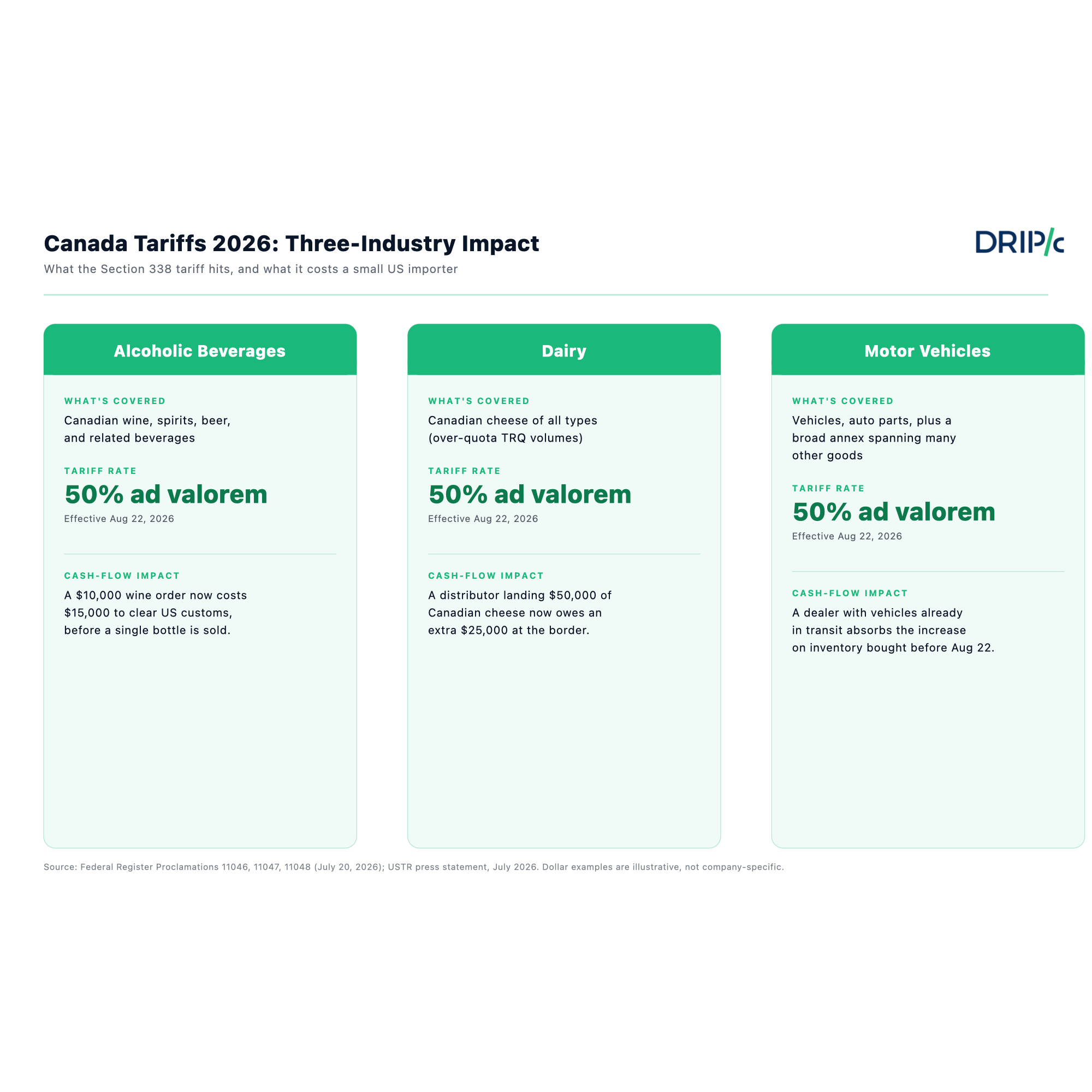
Canadian wine, spirits, and beer are squarely inside the alcohol proclamation's scope. The stated trigger was Canadian provincial restrictions on US alcohol shelf placement, and the US response applies the 50% duty to Canadian products crossing the other direction.
For a small importer or distributor, the mechanics are blunt. A shipment that used to land at, say, $10,000 in cost now clears customs at roughly $15,000 before a single case reaches a warehouse. That extra $5,000 has to come from somewhere: thinner margins, a price increase passed to restaurants and retailers, or cash the business did not budget for this quarter. Distributors who buy on set contracts with Canadian producers are in a particularly tight spot, since renegotiating pricing terms takes time that the tariff schedule did not allow for.
Industry breakdown: dairy
The dairy proclamation targets Canada's tariff-rate quota system for cheese. Canada's TRQ rules under USMCA and its separate arrangement with the European Union treat US cheese exporters less favorably than EU exporters, according to the proclamation's own findings, and the 50% duty is the stated offset.
US importers of Canadian cheese and related dairy products face the same math as alcohol importers: a sudden, non-negotiable jump in landed cost on product that may already be on a truck or a boat. Dairy is also a category where shelf life and contract pricing with grocery and food-service buyers are tight, which leaves less room to simply wait out the tariff or slow-walk a price adjustment.
Industry breakdown: motor vehicles
The motor vehicle proclamation is the broadest of the three. It covers vehicles and vehicle parts directly, but the underlying annex reaches well beyond cars and trucks into a wide range of other goods classified under the same tariff schedule chapters, according to trade counsel who have reviewed the annex in detail.
Small auto parts distributors, independent dealers, and businesses that import Canadian-made components face a double bind. Vehicles and parts already in transit when the tariff took effect are subject to the duty on arrival, regardless of when the purchase order was signed. That means a dealer or distributor can owe tens of thousands of dollars more than expected on inventory that was budgeted and priced months earlier, with no ability to pass that cost back to the Canadian vendor.
The common thread: this is a cash-flow problem
Across all three industries, the pattern is identical. This Canada Tariffs 2026 action does not care when the purchase order was signed or what the sale price to the end customer was already set at. It applies the moment goods clear US customs. That creates an immediate gap between what a small importer budgeted for and what CBP now requires at the border, days or weeks before the business collects payment from its own customers.
This is different from a slow-moving cost increase a business can price around. It is a hole that opens overnight in working capital, right at the point of import, and it is the clearest Tariffs 2026 lesson for anyone sourcing from Canada this year.

What this means for cash flow, and how Drip Capital fits
This US Tariff increase does not change how quickly a small importer's own customers pay. Net 60 and net 90 terms do not move just because the border bill did. What changes is the amount owed at the moment of entry, and that amount is now due well before the imported goods generate any revenue.
Drip Capital sees this pattern often with businesses that source internationally. Vendor Financing is built for exactly the moment before goods ship: it pays the vendor directly, funding the purchase itself, so a business does not need to have the full landed cost, tariff included, sitting in the bank before an order can move. It is collateral-free, requires a minimum of two years in business and $2M or more in annual revenue, and repayment runs up to 90 days.
Drip Capital's Line of Credit addresses a different part of the same problem: absorbing the margin hit while pricing and contracts with downstream buyers catch up to the new cost reality. It is a revolving facility with six monthly installments, no prepayment penalty, and no annual maintenance fee, in a $50,000 to $3 million range, with credit decisions typically returned within about 48 hours and draws funded within 24 hours once approved. Neither product changes the tariff itself. Both are built for the cash-flow consequence of it: the gap between what a business now owes at the border and what it has on hand today. This is the practical, day-to-day side of any Tariff update, separate from the policy debate over the tariff itself. For a broader look at how businesses cover gaps like this one, see Drip Capital's working capital guide.
If your business is also carrying inventory that was hit by earlier tariff actions under a different legal authority, it is worth checking whether any of that duty is refundable; Drip Capital's guide to the Tariff Refund process through CBP's CAPE program covers that separately, since it is a distinct mechanism from the Section 338 duties described here.
FAQ
Is the Canada tariff the same as the tariffs the Supreme Court struck down?
No. The Section 338 duties on alcohol, dairy, and motor vehicles rely on a different legal authority than the IEEPA-based tariffs that were the subject of that ruling. Section 338 of the Tariff Act of 1930 is a distinct statute, and these three proclamations do not depend on IEEPA.
Do USMCA-qualifying goods get an exemption?
No. Goods that qualify for USMCA preferential treatment are still subject to the additional 50% duty if they fall within the scope of Proclamations 11046, 11047, or 11048. Proper origin certification does not remove the tariff here.
When exactly did the tariff take effect?
The duties were originally scheduled for August 19, 2026, then suspended for three days and pushed to 12:01 a.m. Eastern time on August 22, 2026, per Proclamation 11056.
What if my business does not import alcohol, dairy, or vehicles directly?
Check the annexes carefully. The motor vehicle proclamation in particular sweeps in a range of goods beyond vehicles themselves, so a business that assumes it is unaffected because it does not sell cars may still find covered products in its supply chain.
Is this the same as the CBP CAPE tariff refund process?
No, that is a separate topic. The CBP CAPE program addresses tariffs that may be refundable under a different legal track; this Tariff Refund mechanism is unrelated to the Section 338 duties described in this piece.