

No-Doc Business Line of Credit: What Minimal Documentation Actually Means
Search "no doc LOC" and you will find lenders promising a line of credit with almost nothing to sign, scan, or upload. No lender hands out money with zero information about your business; what changes is the form that information takes.
A no-doc business line of credit is really a documentation category: financing evaluated on data the lender can pull or verify quickly, in place of the folder of tax returns a bank usually wants. This guide covers what "minimal documentation" replaces, what it costs, and how a small business line of credit compares with an entirely different instrument that shares an acronym: the SBLC.
What a No-Doc Business Line of Credit Actually Means
It describes an underwriting style
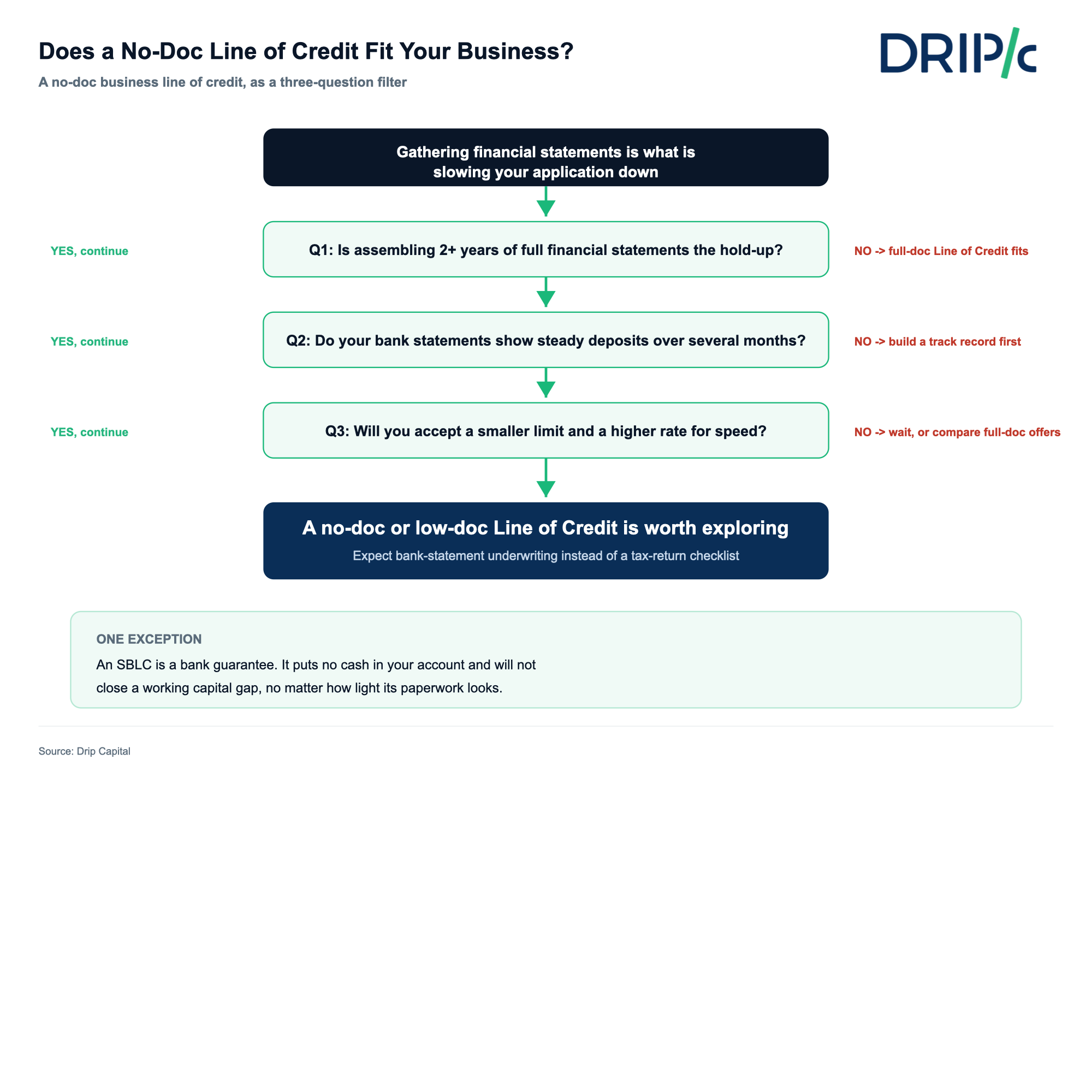
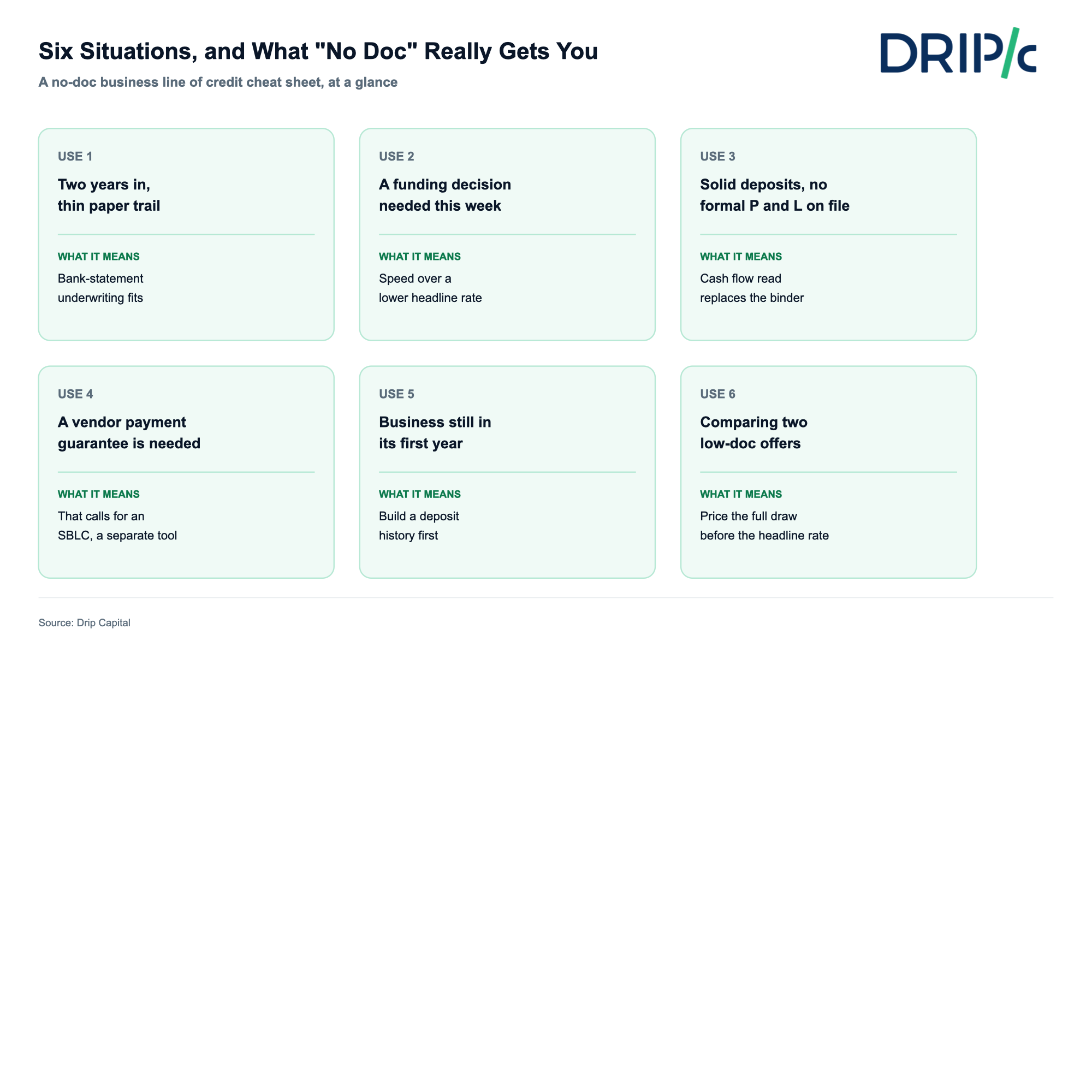
"No doc" and "low doc" get used loosely, and both usually mean the lender skips a request for years of tax returns, audited financials, or a formal business plan, verifying your business instead through bank account connections or transaction history. Nothing about a business line of credit structure itself changes; you still draw against a limit, repay, and draw again. What changes is the proof the lender needs before it opens that limit.
What "no doc" replaces
Traditional applications, especially at banks, often ask for two or three years of tax returns, a profit-and-loss statement, a balance sheet, and formation documents. A no-doc or low-doc process trades most of that for a read-only connection to your business bank account or accounting software, plus basic identity and registration details. Less paperwork means less time assembling it; the level of scrutiny on your business stays about the same.
By the numbers
Why speed and paperwork drive the no-doc pitch
39%
of large bank applicants cited a
difficult application process
23%
of online lender applicants said
the same about their process
86%
of small firms use financing
on a regular basis
60%
of online-lender borrowers found
costs higher than expected
Sources: Federal Reserve Bank of Cleveland, "Clicking for Credit" (2022, based on 2021 SBCS); Federal Reserve Banks, 2026 Report on Employer Firms
Why Businesses Search for Minimal-Documentation Financing
Speed is the real driver
In 2021 Small Business Credit Survey data, large bank applicants were far more likely to cite a difficult application process as a top challenge than online lender applicants were: 39% versus 23%, according to a 2022 Federal Reserve Bank of Cleveland analysis. Bank applicants also reported longer waits for a credit decision. A lighter document request is usually a symptom of a faster underwriting process. A two-year-old company, or one whose owner still files taxes jointly, may simply not have the clean, separable paperwork a bank wants to see.
What Lenders Check Instead of Traditional Paperwork
Bank statements, credit, and transaction history
A connected business bank account shows deposits, withdrawals, and balance trends in real time; lenders read this for cash flow consistency, since steady deposits signal a business that can service a draw on a predictable schedule. A single credit check replaces a stack of documents with a number the lender already trusts, and registration records, account age, and repeat transaction patterns with the same vendors round out the picture.
The Trade-Off: What Minimal Documentation Costs You
Smaller limits, higher rates, and fine print
Skipping deep financial review is a risk the lender prices in. Streamlined credit lines typically carry smaller limits and higher rates. Sixty percent of businesses that borrowed from online lenders reported that their actual costs came in higher than expected, compared with 37% at small banks and 32% at large banks; that gap tends to sit in draw fees or how interest compounds, rarely visible in the headline rate. Our breakdown of hidden line of credit charges walks through what to look for. A lender with less documentation to lean on also often compensates with closer monitoring of the connected account.
Once you understand what a lighter application is trading away, the next step is separating a no-doc business line of credit from a completely different instrument that gets confused with it.
SBLC vs a No-Doc Line of Credit: Two Unrelated Tools
A Standby Letter of Credit backs a promise
An SBLC, or Standby Letter of Credit, is a bank-issued promise to pay a third party if your business fails to meet an obligation, such as a payment term with a vendor. The ICC Academy describes it as a backup payment guarantee that a beneficiary can draw on only if you fail to perform, and most standby letters are never drawn on at all. It does not hand you cash to fund day-to-day operations.
A business line of credit works differently: you draw cash against an approved limit to cover payroll or inventory, and repay what you use. The two get confused because both carry "credit" and a bank standing behind a number, but an SBLC backs a promise while a line of credit puts money in your account. If you are searching for credit lines to cover day-to-day cash needs, an SBLC is not the product category to compare against.
How to Evaluate a No-Doc or Low-Doc Offer
Ask what "connected" means, and price the whole draw
Some lenders want read-only bank access; others want a live feed from your accounting software with ongoing monitoring. Know what you are granting, and ask for the all-in cost of a typical draw, including any draw fee, maintenance charge, or early-repayment penalty.
Confirm the limit actually revolves
A small business line of credit is only useful if it replenishes as you repay. Ask specifically how fast your available credit resets after a draw.
How Drip Capital's Line of Credit Handles Documentation
Drip Capital's Line of Credit does not run on a stack of bank-style paperwork, but it is not zero documentation either. Underwriting looks at your trade performance, cash flow, and financial health, with no hard-asset collateral requirement. A one-time credit decision typically takes about 48 hours, draws fund within 24 hours, and each draw repays over six equal monthly installments, with facilities generally ranging from $50,000 to $3 million.
Frequently Asked Questions
Does a truly no-documentation business line of credit exist?
Not in the strictest sense. Every lender verifies something, whether through a bank connection, a credit pull, or transaction history; "no doc" describes a lighter, faster verification process, with underwriting still happening behind it.
Is a no-doc line of credit more expensive than a traditional one?
Often, yes. Lenders that skip deep financial review typically price in that reduced visibility with higher rates, smaller limits, or shorter terms. The advertised rate alone will not show you that; compare the all-in cost of a draw.
What is the difference between an SBLC and a business line of credit?
An SBLC is a bank guarantee that pays a third party only if your business defaults on an obligation. A business line of credit gives you cash to draw against directly for operating needs.